For many years, students of the Battle of Gettysburg have sung the praises of the Spencer rifle and its contribution to the great Union victory. Numerous authors have suggested that it was the Spencer that helped derail the Confederate attack on the morning of July 1; that General John Buford’s cavalry troopers, armed with their Spencer carbines, repelled wave after wave of Confederate infantry. The contributions of the Spencer to Union victory are not limited to July 1st however. Captain O. E. Hunt, U.S. Army, and Instructor at the U.S.M.A. wrote in his report on The Ordnance Department of the Federal Army: 1860-1865, about the superiority of the Spencer rifle and its use by General John Geary’s 12th Corps soldiers on July 2nd. “Due to the use of the Spencer rifle by part of General Geary’s troops at Gettysburg, a whole division of Ewell’s corps was repulsed by inferior numbers.” Captain Hunt continues: “ Of this action an eye-witness said, ‘ The head of the column ( Confederate) , as it was pushed on by those behind, appeared to melt away or sink into the earth, for though continually moving, it got no nearer.'” As we shall see, Hunt’s report made for stirring reading but like many references about Spencers and Gettysburg it had no foundation in fact.
The Spencer Repeating Rifle
This unique weapon was the invention of Christopher Minor Spencer. Throughout the 1850’s, Christopher Spencer was an inventor and tinkerer. While working for The Colt Manufacturing Company in Hartford, Connecticut, Spencer got interested in gun manufacturing. He tinkered around with the idea of a single shot, magazine fed, repeating rifle which used a large metallic cartridge. In 1860 Spencer applied for and received a U.S. patent for his Spencer Repeating Rifle. Raising capital and securing a manufacturing site in Boston, MA, Spencer began limited production of “his rifle”. Expecting U.S. Government contracts to flood into his new business after the Confederacy was formed and war was a certainty, the 28 year old Christopher Spencer was greatly disappointed. The U.S. Ordnance Department passed on the Spencer rifle in favor of time-tested and less expensive weapons. (In 1860 Spencer priced his rifle at $45.00. In comparison an 1861 Springfield muzzle loader was $14.00).
In 1861 the Navy Department placed an order with Spencer for nearly 1,200 rifles, but the army refrained to follow suit. Spencer decided to market his new rifle directly to Northern state governments. The strategy worked and some governors made purchases of the rifle. Finally, after nearly two years of frustration with the War Department, Spencer secured an appointed to see President Lincoln himself in the spring of 1862 to promote his rifle and secure a contract with the War Department. President Lincoln was impressed with Spencer and his new weapon after a personal shooting exhibition near what is now the Washington Memorial. Federal contracts followed and by 1865 the government had purchased 107,000 rifles or carbines from Spencer. Spencer’s company manufactured over 14,000 rifles and 130,000 carbines by the end of the war. Since Spencer refused to sell to the Confederacy his weapon was available to the Confederates only by capture.
The Spencer Rifle at Gettysburg
By the summer of 1863, production of the Spencer Rifle was stepping up. Along with the rifle the U.S. War Department wanted carbines for its cavalry. But it was not until October1863 that Spencer started delivery on the first order of 45, 733 carbines. Therefore up until the summer of 1863 the only Spencer that was available for purchase to the army was the rifle version. Buford’s men holding back wave after wave of Confederate Infantry with their Spencer carbines is fiction. Company, Regimental, and Division ordnance records of the regiments under Buford show that his troopers were armed with Sharps, Burnsides, Merrills, Ballards, and Maynards. Contrary to Captain Hunt’s assertion that General Geary’s men pushed back an entire division of General Richard Ewell’s men on July 2 and saved the Union right flank with their Spencer repeaters, the truth was there was nary a Spencer in Geary’s division. His ordnance records show his regiments were armed with mainly U.S.1861 Springfield Rifle-Muskets, and also some older 1855 Rifle- Muskets, and even some old smoothbore muskets.
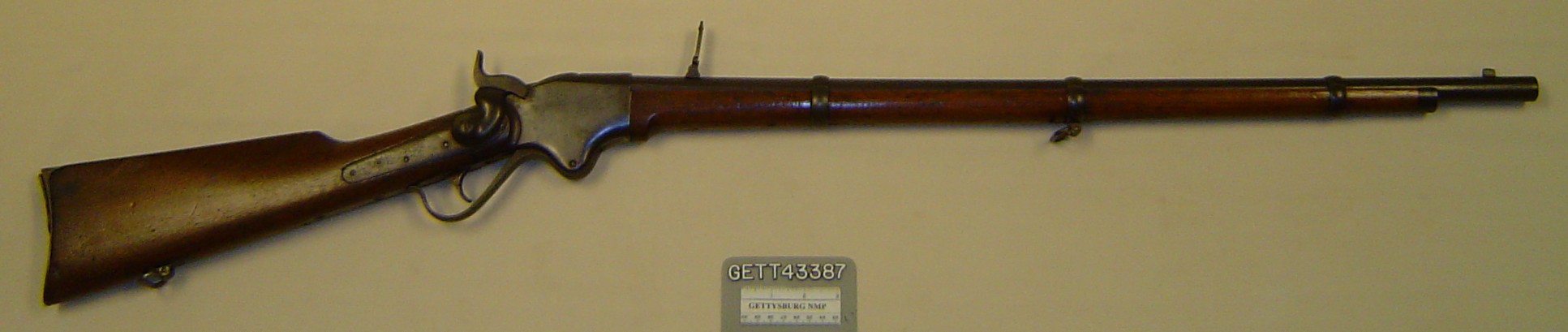
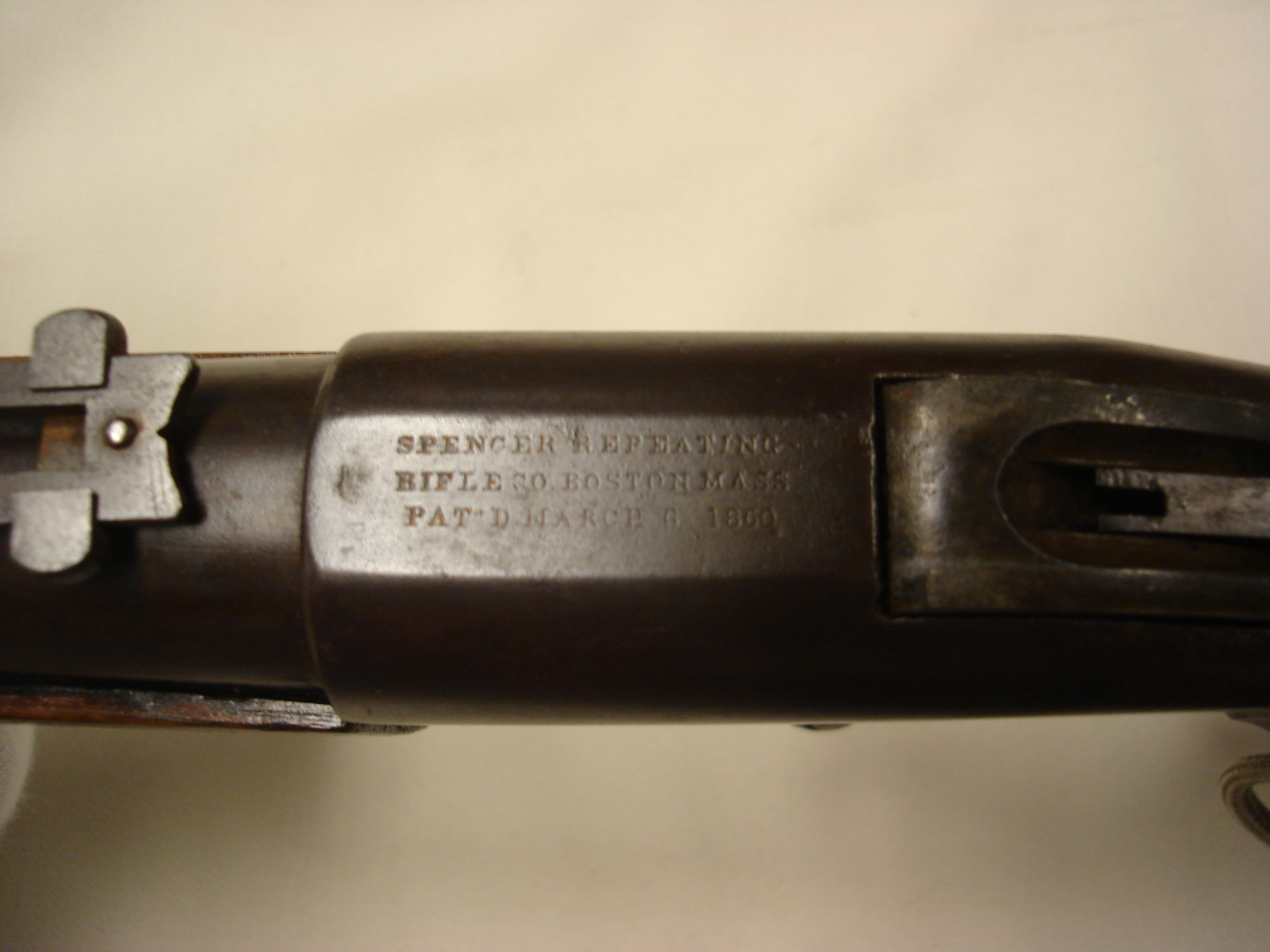
A Model 1860 Spencer Repeating Rifle, .52 caliber, from the GNMP collection. The overall length of the rifle is 47 1/8 inches. It fired metallic rim-fire cartridges from a seven shot magazine. This particular weapon was picked up between Union and Confederate lines by 1st Lieutenant John Patterson, 148th Pennsylvania. It was probably a private purchase weapon. Detail views of the same weapon are shown below. NPS
Only two units of the Army of the Potomac were armed with Spencer Repeating Rifles at Gettysburg. In February 1863, Governor Austin Blair of Michigan purchased 680 Spencer Repeating Rifles (not carbines) with state funds which were then issued to Colonel Russell Alger’s 5th Michigan Cavalry, which during the battle was in Brigadier General George A. Custer’s brigade. Blair and Alger were close friends which accounts for why the 5th was the lucky recipient of these weapons. Alger had nearly 80 of the rifles his regiment received given to a “captain friend” in the sister 6th Regiment Michigan Cavalry, who used them to arm two of their companies. Ordnance records of the 5th and 6th Regiments Michigan Cavalry, submitted a month after the Battle of Gettysburg, indicate these two regiments carried a total of 572 Spencer Repeating Rifles and 10,000 rounds of ammunition to the field. The men of these regiments made good use of their Spencers in the July 3 cavalry battle east of Gettysburg, but this was the only place on the Gettysburg battlefield that the Spencer saw action except for those rare cases of soldiers who had privately purchased the weapon.
Tom Holbrook,
Black Powder Specialist


 The Blog of Gettysburg National Military Park
Excellent article. I love to see long held myths taken down with cold, hard facts. Keep up the great work!
It is interesting to note that the 34th Virginia Battalion of Cavalry which was armed with a mixture of muzzle loading arms more than held their own at the Rummel Farm against the Spencer rifles of the 5th Michigan.
That’s an eye opener! So much for legend…
There is an excellent book on the Spencer by Marcot, and an excellent article by Wiley Sword on the Spencers in the hands of the 5th and 6th Michigan Cav. on the East Cavalry fileld. What is the serial number of the battlefield pick up weapon? The serials of the Michigan Spencers (the first built and issuesd) were 1000-2000. I’ve understodd that some Reb may have ended with one one of the Michigan Spencers from their action at Hanover PA a couple days before–perhaps that’s more likely than private purchase, as there were really no rifles available for private purchase at that time. A great mystery story!
one fact that is incorrect in this article is that the spencer rifle was also used to great effectivenes at hunterstown, july 2, 1864
sorry, 1863
I bought a origional 1860 Sharps carbine at a gun show today #30,791. How do I find out when it was manufactured and to whom it was sold? I think it went to a PN unit during the civil war.
Thanks,
Michael
michaelbunch@myexcel.com
Michael,
Our museum services staff checked their sources and it appears likely that this weapon was issued in May 1865 to the 1st Maryland Cavalry.
Scott Hartwig,
Supervisory Historian, GNMP
Dear Mr. Hartwig –
I’ve written a book (so far unpublished) on the 1st Md Union Cavalry and would be interested to know the source for the issuing of the Spencer rifles to that regiment in May 1865. At the time, they were stationed near Richmond (with one squadron of 4 companies at Ashland) and were suffering from a lack of adequate uniform clothing. In general I have little information on the regiment’s weapons, so I would be grateful to learn more about this.
Pete,
Tom Holbrook is our resident Spencer Rifle expert. I will forward your message to him as well as to our museum staff to see if they can help you.
Scott
Scott –
Thanks for your help. I look forward to receiving further information.
Peter
While you are asking Mr. Holbrook Spencer questions, please ask him if the Spencer you have that was picked up at Culp’s Hill has a serial number on it or not. I mentioned that question here (up stream in this chain, quite a ways back) and haven’t heard. I’ll be at the NPS 150 living history event with the Union artillery on July 1-3, but I think he’ll be too busy for me to pester him then! I have a low serial number Spencer Rifle (the first issued are marked 1000 to 2000) which I like to believe was with the Custer Michigan Brigade at Gettysburg. Thanks, Joe Patchen
Nice job folks. Now, another spencer rifle to trace. My spencer has serial #8851. I have read the Marcot book, but am not as close to an answer as I would like. Any help would be appreciated.
Scott, I have a Spencer Burnside Serial #15967. Any idea when and to what unit this was issued to?
Michael. I have a Sharps if I give you a number will you see what you can find out about it. When I bought it the guy owning it told me that he thought it came from PN. 30791
Michael Bunch
Gentlemen:
Last week at a gun show in Pasadena Texas I got a origional Spenser serial number 30691 patnent date March 1860. The guy I got it from said he got it from an estate in Pittsburge and that it likely belonged to Capt. Samual Taggart. I am trying to verify if this might be true. Please tell me if there are any photos or record of him owning or being issued a Spenser? Where can I find the manufactures records? I think that the PN unit was sold these carbines and that will help me to determin if this is the case. Any references or other leads you can offer would be greatly appreciated. Could this Spenser have been used by another unit at Gettysburg?
Y.O.S
Michael Bunch
11th TX Dismounted
I have a New Model 1863 sharps carbine #c5978 and was wondering if it also came from the 1st Potomac Home Brigade Maryland Cavalry. I have the book called Civil War Sharps Carbines and Rifles by Earl J. Coates and John D. McAulay. In the bood the closest number a came accross was only 18 numbers off. I was hoping you could help me.
Mike,
That is hard to say. Based on the serial numbers for the 1st PHB Cavalry that Coates and McAulay provide it is evident that the weapons were not distributed, or at least did not reach the regiment, in sequential order. What this means is, tracking down what regiment your weapon might have belonged to is not easy.
Scott H.
Buford did not have Spencers at Gettysburg. He had Sharps carbines.
Phil,
Check the post again. That is what Tom Holbrook writes, that Buford did not have Spencers. And, while Sharps were the most common carbine carried by Buford’s troopers, some of his regiments carried Gallager’s, Colt’s or Merrill’s.
Scott Hartwig
Just saw an article in yesterday’s (2012-01-24) New York Times’ Disunion Blog about the Union Army and Spencer Rifles stating (wrongly) that Buford’s cavalrymen were armed with Spencers in their opening actions at Gettysburg. Interesting article otherwise, that did a good job explaining why the Spencer didn’t get into more Union hands sooner than it did..
I wrote that NYT article and it said Buford had Sharps carbines.
–Phil Leigh
On July 1st 1863, Bufords Cavalry Division was armed as follows:
1st Brigade – Col William Gamble
8th Illinois – Sharps carbines
12th Illinois – Burnside carbines
3rd Indiana – Gallagher and Sharps carbines
8th New York – Sharps Carbines
2nd Brigade – Col Thomas Devin
6th New York – Sharps carbines
9th New York – Sharps and Smith carbines
17th Pennsylvania – Merrill and Smith carbines
3rd West Virginia – Gallagher and Smith carbines.
Reserve Brigade – BG Wesley Merritt [Not with Buford on the first day at Gettysburg]
6th Pennsylvania
1st US
2nd US
5th US
6th US
All the above regiments were armed with Sharps carbines.
Source – Ready, Aim, Fire !! Small Arms Ammunition in the Battle of Gettysburg by Dean Thomas. Pages 65-66.
Phil;
Interesting…it lists in Merrits Reserve Brigade the 1st thru 6th US. Was this the US Sharpshooters? If so, I was always under the belief that they were issued the Rifle, not the carbine. If I’m mistaken, I just wonder why a Sharpshooter regiment would be issed a carbine, as the Rifle proved more accurate at distances exceeding 100 yards
Regards,
Phil Spaugy
Sent from my iPhone
Dave,
The listed regiments in Merritts brigade were US Regular Cavalry regiments.armed with Sharps carbines.
I have an original Spencer Repeating Army Rifle, serial number 2725 that was purchased in an estate auction in Western Colorado around 2006. It has very nice metal, and decent bore and typical dried out wood, indicating that it has been in the dry West for a considerable time.
Were any rifles in this serial number range used in the Battle of Gettysbury, or do I have George Custer’s original rifle(just jesting)??? I am trying to trace some of the history on this rifle and having little luck. I have no doubt that a CW veteran brought it into Western Colorado, since it was a modern rifle at the end of the war, the muskets were obsolete and why would anyone bring an obsolete rifle into Indian country.
There is an excellent book on the Spencers by Marcot. I have two original Spencers just on either side of your serial number so I’ve looked at thsi alot. Numbers 1000 or so to 2000 went to the 5th and 6th Michigan Cav under Custer and helped him beat Stuart and get famous. The next lot–maybe yours–went to the Ohio Sharpshooter companies which served as body guard units for all the great generals of the Western theater. The next batch–also maybe yours– went to to the Wilder Lightning Brigade. The men could buy them at the end of their service for about 10$, and the Army used a bunch of them out west after the war. They were highly prized, so they would have been a handy tool for many years after the war Get that book, you’ll love it! Joe Patchen.
What is the name of the book?
Great article. I found a Spencer at a gun show in Pasadena Texas. How do I locate the date of manufacture from the serial number? Michael
Joe Patchen:
Thanks for the kind remarks regarding where my Spencer might have been used. I did pick up a very nice Model 1861 Rifle-Musket from the estate of a long time Civil War history buff, and the muskets were rare in the West, well before Bannerman’s started selling them to the GAR members(the origin of the great majority of “Grampa’s CW Musket), again why would a CW vet carry a obsolete rifle-musket into western Indian territory when Spencers were available, and the Indians had Spencers and Henry’s. George Custer can confirm that. Thanks again.
I had to come here just to be sure of the facts. Unfortunately, B.M. Gottfried’s “Brigades of Gettysburg” perpetuates this myth on page 614 when discussing the actions of Davis’s brigade on July 1. I stopped when I read his statement “Buford’s dismounted cavalry, armed with new six-shot Spencer repeating rifles.”, scratched my head, and said “this can’t be!” Unfortunately he did not list a reference so I still didn’t know where this myth came from until I read this article. Thanks!
The ancestor of the guys that perpetuated the $50.00 surplus jeeps at the port of entries after World War Two and the “ping” of the empty M-1 Garand clip exiting the magazine and “pinking” on the .ground must have perpetuated the myth on Buford’s Unit, Apparently no, on the ground evidence used, just copying others’ misconceptions, an early rewrite of history, so very common today. No crate jeeps were available for $50.00 after the war,and the “ping” of the M-1 clip never gave positions away. You would have to have the hearing of “Superman” to hear the “ping” in a noisy battle, as for the $50.00 jeeps, they never existed after the war. Early on crated jeeps were sent to Russia and one would find examples in the bottom of the North Sea in torpedoed allied freighters. Most good running WW2 jeeps still stateside on training bases brought good money after the war, and a great many were donated to schools, emergency services and other government agencies. It really bothers me, being a student of history, that myths never seen to go away and people will believe without doing any research, seems like the CIA did that in about 2003 or so.. The internet is now the classic perpetrator of Urban Legends, but this has been going on for centuries. I was under the impression that some(and not all) of Custer’s men were using Spencer Rifles in the Battle, but my Spencer apparently was not one of them, it is SN 2725, possible with Wilder’s Units or the Ohio Separate Sharpshooters, in the west(well now midwest). I know this is somewhat off topic, but these are examples of Urban Legends that never seem to go away.
I have recieved a Spencer Repeating Rifle with the serial #1554 .I would like to know which troops recieved this rifle and if it was used in or near Gettysburg. Thank You Very Much
Terry,
The only regiments armed with Spencer rifles were part of the 5th and 6th Michigan Cavalry, which were part of Custer’s brigade, Kilpatrick’s division. We do not have the serial number information for the rifles that were issued to these regiments so cannot tell whether yours might have been one of them.
Scott H.
Mr. Tucker–see my 12/18/11 and 6/8/12 comments, above. If you really have a .56 Spencer Rifle, that serial number should be among the first 1000 made and issued, which almost certainly went to Custer’s Brigade and were first used at Gettysburg.
I have been looking for a resource for some time that would help me verify where my spencer rifle served and who might possibly haved owned it. I have owned it since I was 10, my dad bought it from an old black man while on a construction site for 10.00 in Montgomery, Al. The serial number is really hard to make out and I have refrained from using anything on it. It is in really good condition.
Do not believe that Custer was a General at Gettysburg. Believe his rank was Captain.
Custer was a captain in the regular army but a brigadier general in the volunteer army. He had been promoted to brigadier general on June 28, three days before the battle began.
Scott H.
I have a VG M1860 Spencer carbine, SN: 12648, recently acquired. Can any Spencer afficiandos out there tell me if this specific firearm carbine has any history for any particular battle?? Would be much appreciated.
Regards,
Mark –
Mark,
I have SN; 12638. Let me know what you find
I have 12800 and was told it came out of PA during the war but I have not been able to verify that.
Michael
I am looking for any information that you can provide on a Spencer Repeating Rifle Pat’d March 6,1860 serial number 20061.
Thank you for any information.
Walt
I am also looking for information on A spencer I just found.
Pat’d March, 1860 serial number is 1746
Also I was wondering how much to sell it for?
If it was a rifle not carbine and a true 1860 model that serial number means it is one of the first 1000….see Wiley Sword’s article. And means it was with the Michigan Brigade with Custer. I have one also.
Hi Patrick
Are you interested in selling your Spencer sn # 1746 ? Philip
Yes I am. michaelbunch@myexcel.com
Can anyone tell me how much either the Spencer rifle or the Spencr carbine was sold for duirng the Civil War?
In his 1861 proposal to the U.S. War Department, Christopher Spencer offered his complete repeating rifle for $40 each, which included the angular bayonet. Carbines, produced in 1863, were less, the exact price varying somewhat as each contract was filled. You can find an excellent history of Spencer’s efforts to sell his exceptional weapons to the military in the book by William B. Edwards, “Civil War Guns” (Stackpole & Co., Harrisburg, PA, 1962)
In 1863, the 1860 Spencer carbines were first contracted on June 3, 1863 to the Ordinance Department at $25.00 each for 7,500 carbines. Referencing Roy Marcot’s, “Spencer Repeating Firearms” book, pages 62-64. The model 1860 Spencer Navy with bayonets were contracted for $43.00 each. Chapter 2 of Marcot. The Army Spencer rifles were initially contracted for $40.00 with bayonets for 7,500 pieces. Chapter 3 of Roy Marcot’s book. Price did vary as numbers and contracts increased.
Thanks to all for this great article and subsequent discussion! I have a Sharps New Model 1859 Carbine, #46212. I consulted the Coates/McAulay book without success, does anyone have further resources that might help me identify the unit it was issued to? Thanks in advance for the expertise here!!!
Unfortunately our resources at the park are inadequate to identify which unit may have received the Sharps carbine you have. Further research with enthusiasts on discussion boards related to Civil War weapons may help. Good luck!
I am looking for any available advice or information on a spencer carbine ser.#8167
I have one for sale? Interested?
I am currently researching values. So unfortunately at this time not looking to purchase anything at the moment. Thank you very much for your time and offer.
John: OK I understand. Keep my address and let me know when you are ready.
Michael
This is to a recent post. I am NOT interested in selling my spencer rifle. No idea how this ended up in my name, pards.
Did you have any luck here gaining information on the guns history??
Yes, I got an approximation for the unit and a range of serial numbers. If you join the Spencer Shooting society, the gentleman there has some valuable into. You are expected to join the society( at no cost) and submit info that others owning original spencers may be interested in.
John: No because the factory records were destroyed in a fire many years ago. What I can suggest is that do your best to figure where the item lived the most then contact the historical societies and military units there at the time.
i do appreciate your time and comments. This is not an easy process!!! However its fun to learn new things every day.
Does anyone have an idea as to how one can trace the history of a Burnside Spencer carbine serial number 3032 ?? Funny thing about it is that it has o the right side of the stock the number 79 stamped in it !! The number was not etched in by hand but stamped with a slightly embellished style not just straight numerals !! I am sure that there is a technical term for the style – I just don’t know it !! I know some of the Burny Spencers were shipped overseas !! Maybe this was and found its’ way back home !! it looks like it saw action ! Thanks in advance for any return on my query !!!
Hello
I have acquired a rifle that has Spencer Rifle Company stamped on it. It has what appears to be 29,018 stamped into it behind the hammer on top of the gun. How do I find out more information on this rifle?
Thanks, Lloyd
Gettysburg National Military Park does not have the resources to research serial numbers on Spencer Rifles. We suggest you contact experts in the field of Civil War-era weapons for additional resources and information.
Lloyd. The Spencer Shooting Society can offer some help. Your are only asked to join the society online at no cost. Just do a web search. I was able to get my info that way. Good luck.
I have a Spencer Carbine 1860 that is serial #385 (very early) would like to know more regarding its history in the Civil War
One of my Spencer rifles serial number is #2725, and it was made in about February or March of 1863; they were made before the Spencer Carbines were produced. Spencer carbines initial manufacture started summer or early fall 1863. Something is amiss, possibly yours Spencer was converted into a carbine form later on. In that case, it may have been used in the Battle of Gettysburg in rifle form, not carbine form. Interesting!!
My spencer carbine has the serial# 11385. From what I have read and heard from experts the carbine serial numbers start at 11000– Frank Parrish
I think yes I think that’s right. They didn’t start again at zero when they began making carbines.if you have a very low number carbine it might be a model 1865 rather than a remanufactured rifle.
My carbine is an 1860 spencer carbine.
Some members of the Penn. Volunteer Cavalry purchased Spencer carbines in this very early range, but I would like more info. if possible.
I am still interested to know more about my 1860 model spencer carbine serial # 11385 (very low). It is a saddle ring carbine and is definitely an 1860 Spencer carbine!
I recently acquired a Spencer .56 .56 The only visible marking is serial number 1649.It hasn’t a rear sight, looks like it never had one. Any ideas?
I have a Spencer carbine serial number 2125 and wondered if it was in fact at the Battle of Gettysburg? Thanks. Ron D, NJ
No. No carbine had been ordered or built at the point in time. Spencer rifles.only until about October 1863.
Pingback: General John Buford's Spencer Carbine Rifles
My ggrandfather Amos Reed Bingham enlisted and served in Company M, Michigan 5th Cavalry. In his (never published) memoirs he writes:
“We drew our arms very soon after our arrival in Washington, Spencer Rifles, Colts Revolvers, and sabers. We were the first regiment armed with Spencer Rifles (my gun was #51) and I still think it the best service gun I have ever seen. They were seven-shooters. I have seen one knock a man over at half a mile and that is far enough; anyone further away than that ought to be safe.”
About the events of May 6 1864 he writes “Once on the woods we halted, dismounted and charged back at the enemy. We were close on them before we could see them, and when our seven-shooters got such a chance as that nothing could stand before us. In the meantime our Artillery had got to work on the other side of the field and everybody had plenty to do.”
He was wounded at Yellow Tavern May 11 1864 and while riding with the rest of the wounded he observed “A Regiment of our dismounted men was trying to force a passage at the ford across the (Chickahominy) River but was driven back. Immediately another Regiment came down to the River but they were also driven back by the fire from the other side. Just at that time General Sheridan and his staff rode up and stopped within a few feet of me, and close enough so that I could hear every word he said.
As soon as he stopped a staff officer rode up and saluted and said, “General Wilson sends his compliments to General Sheridan and says he must have help as he is very hard pressed”. General Sheridan answered, “Give my compliments to General Wilson and tell him to hold on, I am going to fix a door for him”. With that he turned to another officer and said, “Go and give my compliments to General Custer and tell him to send the Fifth Michigan Cavalry to force a passage across that ford, I think they can do it”. That was my Regiment. The Fifth came up a gallop, dismounted close to us and went down to the River on the run. There was a fringe of bushes along the River that concealed them till they were right at the River bank, when they were not more than two hundred feet from the enemy, and when they got that close with seven-shooters they were equal to five times their number with muskets. It looked as if they had set the woods on fire, and in two or three minutes the Johnnies began to run out of the bushes on the other side. A brigade of cavalry hurried down to the ford and crossed, and the Fifth returned to their horses.
I at once crossed the River and saw no more of the battle, but it did not last long. Everything drew back across the Chickahominy and was not followed by the enemy.”
Great post. I enjoyed the reading whether published or not.
Thanks for sharing – excellent piece of history.
Thanks for the diary entry. My great, great-grandfather Honore Francois Defer was a trooper in Co. C of the Fifth. Born in Switzerland,died in Detroit.
Hi there. I purchased a 1860 Spencer with serial number 1646. Can anyone advise how many original Spencers ordered by Lt Col. Joseph T Copeland for the 5th Michigan Calvary may still exist today?
I’ve been a Spencer collector for many years, and also interested especially in arms used at Gettysburg. One element of confusion is that the later Spencer Model 1865s and the Burnside Contract Spencers had a duplicate serial number range with the Civil War Model 1860 Spencers. By that, I mean the serials on the Model 1865 started at Serial number 1, as did the Burnside contract 1865 Spencers. This means, as an example, there would be three serial number 1,500 Spencers manufactured, the first a Model 1860 rifle,one of the very rare Copeland Spencers that went with the Michigan Cavalry to Gettysburg, the second a Model 1865 Spencer made in 1865, and the third a Burnside Contract Model 1865, also made in 1865. Since these later guns did not see the hard use of the Model 1860s, there are many low serial carbines around that, if you look, are marked on the barrel “MODEL 1865” or on the breach “Burnside Rifle Co / Model 1865.”
All the early Spencers were rifles, and the earliest Model 1860 carbines made started at about serial 11,000.
All this means that if you have a carbine with a four digit serial number, it is not a Model 1860, and would have been a Model 1865 or Burnside, made at the very end or after the War.
Jeff, Thanks for your comments. I have a Spencer Carbine serial number 8167, not a burnside. Any info you would be willing to share would be much appreciated.
John
Oops it says 1865 on top of barrel
I have an 1860 saddle ring carbine serial # 11384 that was a range match to 19th Penn. vol. cavalry
. Which battles are connected to this early carbine?
There are no Model 1860 Spencer carbines with such a low serial number
I HAVE a Spencer model 1860 Carbine serial 11384 !! Don’t tell me it doesn’t exist!!
Jeff,
Thanks for the information. My Spencer is definitely a rifle. Was one of the 1,200 purchaced for the 5th Michigan Calvalry. John if you go to CAS City forums and join the Spencer Shooting Society, it’s free, there are people on that forum that can probably give you some info.
Spencer 1860 model carbine serial# 11384 please let me know particulars on this very low serial # Carbine if anyone is familiar with which troops received the first issue of carbines.
As you’ve read in this threat, the rifles were all made first, some in time to have been involved at Gettysburg, and then Spencer offered to make shorter barrelled carbines for less money. The first carbines were accepted by the Union in the autumn of 1863.
I am familiar with the Spencer rifle at Gettysburg. I was hoping to get info on the first SPENCER CARBINES. Mine is one of the very early ones serial# 11384. Which regiments got the first ones after Gettysburg?
Nearly 3 years and no one has replied with information on my early 1860 Spencer carbine ser.#11384 ! Help please.